Before we go further, let’s settle something.
Most people hear “Hydra” and immediately picture a giant, many-headed serpent from Greek mythology, terrorizing villages and growing two heads every time someone cuts one off. That creature is famous, dramatic, and honestly exhausting to deal with even in a story.
But that is not the Hydra we are here to talk about.
The real Hydra is something far quieter, far smaller, and in many ways far more terrifying. Not because it will eat your village. But because it is sitting in a pond near you right now, doing something that no human being on earth has ever been able to do.
It is simply not aging.
First, the Greek One (Because It Is Too Good to Skip)
Look, we cannot mention the Hydra without spending a moment on the mythology. It would be like visiting someone’s house and ignoring the very loud, very dramatic relative sitting in the corner.
Let’s talk about a creature that made arguing with a stubborn person look easy.
The Hydra. A giant, many-headed, swamp-dwelling serpent from ancient Greek mythology that had one superpower so frustrating it could make a grown hero cry. You cut off one head? Congratulations. You just gave it two more. You basically helped it grow.
At some point, fighting this thing was less like a battle and more like trying to cancel a subscription you never signed up for.
But let’s start from the beginning.
Where Did Hydra Even Come From?
Nobody in ancient Greece sat down one morning and said, “You know what the world needs? A polite, well-behaved monster.” No. Instead, the gods gave us the Hydra.
The Hydra’s parents were Echidna and Typhon, which is the Greek mythology way of saying: it had the worst family tree imaginable. Echidna was half woman, half snake, and she lived in a cave. Typhon was described as one of the most terrifying creatures in all of Greek mythology.
Together, they had children like Cerberus (the three-headed dog guarding the underworld) and the Chimera. The Hydra was simply another normal Tuesday for this family.
The Hydra made its home in the swamps of Lerna, near Argos in Greece. Not a nice apartment. Not a cozy cave. A swamp. Dark, smelly, miserable. Very on brand.
What Did Hydra Look Like?
Picture a giant snake. Now give it multiple heads. Now make each of those heads sit on a long, separate neck. Now imagine it coming out of murky swamp water straight toward you.
You’re welcome for that nightmare.
The exact number of heads was something ancient storytellers could never fully agree on. Some said nine. Some said seven. Some said as many as thirteen. The point is, there were too many heads. Any number more than one was already a problem.
One of those heads was immortal. Completely unkillable. Not even fire or a sword could destroy it. You could chop it off and bury it under a rock, and that was about the best you could do. Think of it as the monster’s emergency exit that could never be sealed.
And if the heads were not enough trouble, the Hydra’s blood was poisonous. Its breath was poisonous. Even the tracks it left behind when it walked were poisonous.
If you walked past a sleeping Hydra without knowing it, you could breathe in the air around its footprints and die. Just from the footprints. Ancient Greeks were really not playing around with this one.
The Regeneration Problem
Here is the part that makes the Hydra genuinely one of the most infuriating monsters ever invented.
Every time a hero cut off one of its heads, two new heads grew back in its place. Two. For every one you removed.
Think about what that means practically. Say the Hydra starts with nine heads. You cut off one. Now it has ten. You cut off three more. Now it has fifteen. You cut off five. Congratulations, you have now given it a full-grown second Hydra worth of heads and you are probably sweating, exhausted, and rethinking your life choices.
This is why the Hydra has become a symbol for problems that multiply the more you try to fight them head-on. Politicians use this analogy. Economists use it. Cybersecurity experts use it. Even modern-day drama on social media could qualify.
You try to shut down one argument and suddenly five new ones appear. The Hydra understood the assignment.
Hercules Had to Deal With This Hydra Guy
Now, the gods, in their infinite wisdom, decided that Hercules needed to go kill this thing.
This was his Second Labor, part of the famous Twelve Labors of Hercules, which was essentially his punishment for a terrible thing he did while temporarily driven mad by the goddess Hera. The gods were not known for light punishments.
So Hercules showed up at the swamp. He shot flaming arrows into the Hydra’s lair to lure it out. The Hydra emerged. And Hercules, one of the strongest men who ever existed in mythology, started chopping heads off with his sword.
Then the heads grew back. Two for every one.
At some point, Hercules must have stood there in that swamp, sword in hand, looking at a monster with more heads than when he arrived, and thought: “This is not going well.”
Here is where his nephew Iolaus stepped in with the smartest idea of the whole story.
Every time Hercules cut off a head, Iolaus quickly burned the stump with a torch, sealing it so no new heads could grow. It was messy. It was probably extremely unpleasant to be anywhere near. But it worked.
Head after head came off. Stump after stump got burned. The Hydra ran out of heads.
Except for one. The immortal head. That one could not be destroyed by fire or blade. So Hercules buried it under a heavy rock.
And that was that. Sort of.
Because as a bonus, Hercules dipped his arrows in the Hydra’s poisonous blood before leaving. Those arrows became deadly weapons he carried for years afterward. The Hydra, even in death, kept on giving.
The Hera Intervention (Because of Course)
If the Hydra alone was not enough, the goddess Hera, who absolutely despised Hercules and never missed a chance to make his life harder, sent a giant crab to assist the Hydra mid-battle.
The crab pinched at Hercules’s feet, presumably trying to distract him while he was already fighting a multi-headed poisonous swamp monster.
Hercules crushed the crab under his foot and kept going.
The gods later placed the crab in the sky as the constellation Cancer. So the next time someone asks you about your star sign, feel free to mention that Cancer was essentially born from a crab that picked a fight with Hercules and lost badly.
The Real Hydra (Yes, There Is One)
Here is the part where mythology meets science in the most unexpected way.
There is an actual living organism called the Hydra. It is tiny, freshwater, and looks nothing like the monstrous snake of Greek legend. But scientists named it after the mythological creature for one very specific reason: it can regenerate.
Cut this tiny organism and it can regrow the missing parts.
Scientists have studied it extensively because of this remarkable ability. It is living proof that sometimes the most terrifying ideas in ancient storytelling have a quiet, microscopic echo in the real world.
Nobody is losing sleep over the real Hydra. But the ancient Greeks certainly lost sleep over theirs.
So What Exactly Is the Real Hydra?
A hydra is a tiny freshwater animal, typically only a few millimeters long, that lives in ponds, lakes, and slow-moving streams around the world. Not a swamp. Not a cave guarding the entrance to the underworld.
A regular pond. The kind you probably walked past last week without a second thought.
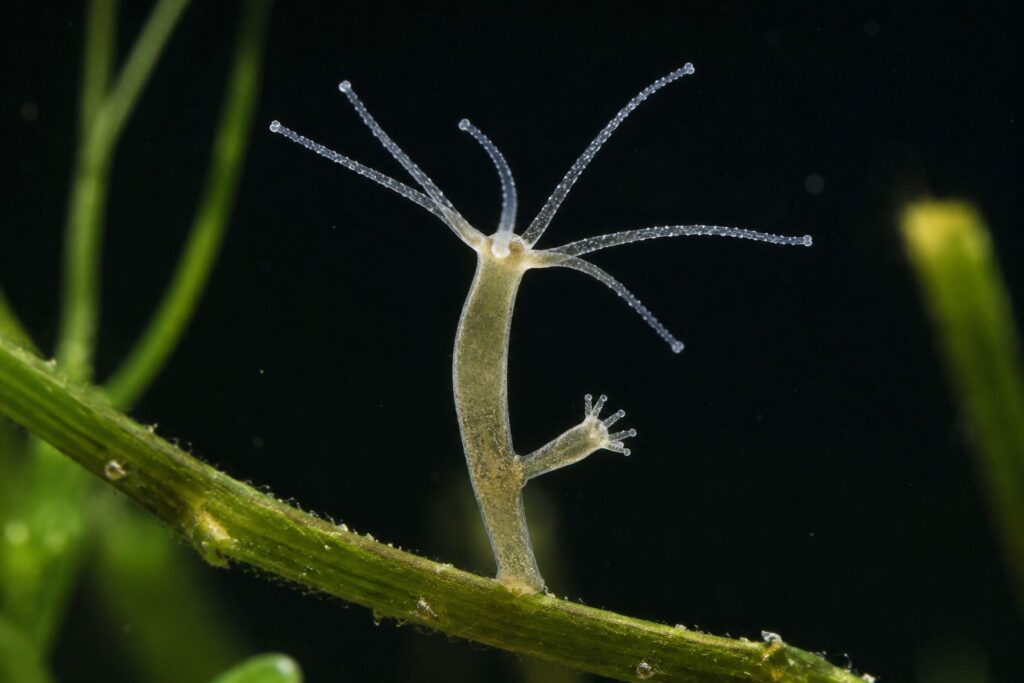
Its body is a hollow column with walls only two cells thick. Its head is just a bunch of tentacles surrounding a mouth, with no eyes or brain. The whole thing is about as long as a grain of rice.
A grain of rice. That is what all this fuss is about.
Hydra belongs to the phylum Cnidaria, making it a distant relative of jellyfish, corals, and sea anemones. So if you have ever been stung by a jellyfish at the beach and dramatically announced that your day was ruined, you now know you share an enemy family tree with the Hydra.
At one end of its body is a dome-shaped structure called the hypostome, which surrounds a single opening that serves as both mouth and waste exit.
Yes. One opening. For everything. The Hydra eats and, how do we put this politely, takes care of business through the exact same hole. This is either a brilliant design or a terrible one, and scientists have been too polite to say which.
The Hunting Scene (Which Is Genuinely Terrifying at Microscopic Scale)
Do not let the size fool you. The Hydra is a predator, and a very effective one.
While feeding, Hydra extends its body to maximum length and then slowly extends its tentacles. Despite their simple construction, the tentacles are extraordinarily extensible and can be four to five times the length of the body.
Imagine someone who looks very small until they suddenly stretch their arms out to five times their own height. That is what the Hydra does while waiting for dinner.
The tentacles are covered in what can only be described as biological weapons. Each tentacle is clothed with highly specialized stinging cells called cnidocytes. These contain structures called nematocysts, which look like miniature light bulbs with a coiled thread inside.
Upon contact with prey, the contents of the nematocyst are explosively discharged, firing a dart-like thread containing neurotoxins into whatever triggered the release.
Microscopic harpoons. Loaded with poison. Fired automatically on contact.
Within 30 seconds, most of the remaining tentacles will have already joined the attack to subdue the struggling prey. Within two minutes, the tentacles will have surrounded the prey.
The whole thing is over in minutes. The prey gets paralyzed, wrapped up by tentacles, and pulled into that one-hole system we discussed earlier. The Hydra can stretch its body wall considerably in order to digest prey more than twice its size.
A creature the size of a grain of rice, eating things twice its own size, using microscopic poison harpoons that reload automatically. If this thing were the size of a dog, no pond in the world would be safe.
Fortunately for the rest of us, the Hydra’s nematocysts are harmless to humans. You could touch one with your bare hand and feel absolutely nothing. Which is both reassuring and, honestly, a little bit insulting.
Now for the Part That Makes Scientists Lose Sleep
Here is where the Hydra stops being just an interesting little creature and starts being something that makes biologists question everything they thought they understood about life.
The Hydra does not seem to age. It is an observation that defies scientific expectation and evolutionary theory, and has led some to describe the species as biologically immortal.
Let that sentence sit for a moment.
It does not age. Every other multicellular animal on earth ages.
Your body is aging right now, as you read this. Cells accumulate damage. Things slow down. Parts stop working as well as they used to. This is the deal that every living thing with more than one cell has signed, apparently without reading the fine print.
The Hydra did not sign.
The key finding in studies was that mortality did not increase with age. A Hydra that had been alive for decades was no more likely to die in a given year than one that had just been born.
Fertility rates stayed constant too. No other species has been conclusively shown to achieve this under controlled conditions.
One researcher named Daniel Martinez set out specifically to prove this was wrong. He believed that with careful observation and experimentation he could catch a Hydra in the act of growing older. He cultured specimens, watched them carefully, and waited for signs of decline.
He later said, “I started my original experiment wanting to prove that Hydra could not have escaped aging. My own data has proven me wrong, twice.”
Twice. The man tried twice to prove that normal rules apply to this creature, and it refused to cooperate both times.
One predicted laboratory lifespan for a common Hydra species is 1,400 years. Not 14. Not 140. One thousand, four hundred years.
The Secret Is in the Stem Cells
How does it do this? The short answer is stem cells, and lots of them.
The Hydra’s potential immortality is made possible by its reproductive system. It is an asexual being that reproduces by producing buds in its body wall, which grow to be miniature adults and simply break away when mature.
For this to work continuously, each polyp contains stem cells capable of continuous proliferation. “Hydra is a bag of stem cells,” one researcher put it. “It is an adult produced by embryonic cells, so it is really a perennial embryo. The genes that regulate development are constantly on, so they are constantly rejuvenating the body.”
The body never gets the memo that it is supposed to slow down. The development genes stay on like a light switch someone forgot to turn off. And the result is a creature that keeps renewing itself, over and over, without wearing out.
The molecular explanation centers on a gene called FoxO, which is strongly active in all three of Hydra’s stem cell populations.
When researchers boosted FoxO activity, stem cells proliferated faster. When FoxO was suppressed, stem cell activity dropped and population growth rates fell.
Here is the part that makes it personal for us: many of the genes involved in the Hydra’s healing process developed early in the course of evolution, meaning they are shared among many animals, including humans.
The FoxO gene is present in humans too. Ours just does not work like the Hydra’s does.
Scientists believe that if the Hydra’s regeneration ability can be fully understood, it could potentially point the way toward treating degenerative diseases in humans, or slowing aging itself.
So this tiny, pond-dwelling, grain-of-rice-sized creature might one day help us live longer. The least dramatic looking thing in the water has the most dramatic potential in science.
The Regeneration That Gave It the Name
The real Hydra earned its mythological name fairly.
If a Hydra is cut into multiple pieces, each fragment can regrow into a complete, fully functional individual. Even a small piece of tissue can regenerate an entire animal within a few days.
A Hydra that is cut in half can regenerate the parts that were cut away, meaning the mouth and tentacles can regrow a new foot, and the section with just the foot can regrow a new mouth and tentacles.
Cut it. Both halves become new Hydras. The top becomes a full creature. The bottom grows a new head and becomes a full creature. You have not killed it. You have made two of them. You have, in fact, done exactly what Hercules did in the myth, except without the fire to stop it.
Scientists have described a Hydra surviving after being put in a blender and centrifuged. It reassembled. From blender fragments. If that does not end the conversation about how remarkable this organism is, nothing will.
Abraham Trembley, a mathematician born in Geneva, accidentally discovered the regenerative capacity of the Hydra in 1740. He reportedly could not believe what he was seeing. He cut one. It came back whole. He cut it again. It came back again. He kept cutting. It kept coming back.
The man just wanted to understand a small pond animal and instead stumbled into one of the most profound biological discoveries in history.
So Can The Hydra Survive Outside Water?
Short answer: no. And honestly, good.
The Hydra has fully adapted to a freshwater existence and has never ventured onto land. Everything about it, its hunting, its digestion, its reproduction, its entire body structure, depends completely on being submerged in water.
Take it out of water and it is just a tiny, confused tube with no plan.
As a freshwater organism, the Hydra faces the constant challenge of preventing excessive water uptake due to osmosis. It manages this through specialized cells and processes that actively pump out excess water, maintaining its internal osmotic balance. Outside of water, that system has nothing to work with.
The Hydra does not have lungs or a respiratory system that could handle air. It breathes by absorbing dissolved oxygen directly through its body wall while submerged. No water, no oxygen exchange. Simple as that.
Its body is also made of two very thin cell layers held together by a jelly-like substance. Out of water, that structure would lose moisture and collapse quickly.
It does not have a protective shell, a tough outer skin, or any of the biological armor that land animals have developed over millions of years of evolution. The Hydra simply never needed those things, because it never left the pond.
While generally sessile, the Hydra can move by a process called somersaulting, where it detaches, bends, reattaches its tentacles, and then reattaches its basal disc further along. But this movement is entirely underwater. It is not crawling toward the shore. It has no interest in the shore.
The shore is a place where all its food is unavailable, all its water is gone, and everything about its biology stops working. If the Hydra had opinions, the shore would be at the very bottom of the list.
It is also sensitive to water quality, which is a different kind of fragility. The Hydra has a low tolerance to pollution and cannot be found in impaired waters.
So while it cannot handle dry land, it also cannot handle dirty water. It is an organism with very specific requirements and absolutely no interest in compromising on them.
Think of it this way. The Hydra has been perfecting its freshwater lifestyle for around 700 million years. It does not age, it regenerates from pieces, it hunts with microscopic harpoons, and it may live for over a thousand years.
In exchange for all of that, it simply cannot leave the water. That seems like a perfectly reasonable trade.
The mythological Hydra terrorized land and swamp alike without limits. The real one is more sensible. It found the best pond it could, attached itself to a rock, and decided that was enough.
One More Strange Thing Before We Wrap Up
The Hydra has no brain. No eyes. No heart. No lungs. Its body is a hollow tube made of just two cell layers with a jelly-like substance in between. It is about as simple as a multicellular animal can possibly be without technically falling apart.
And yet it hunts. It digests. It reproduces. It rebuilds itself from pieces. It does not age.
Meanwhile, humans, with our enormous brains and complex nervous systems and centuries of accumulated scientific knowledge, still cannot figure out how to make a knee that does not start complaining after 40 years.
The Hydra has been on this planet for hundreds of millions of years. Cnidarians, the group the Hydra belongs to, are among the oldest forms of multicellular life known, with a fossil record reaching back 700 million years.
It was here before the dinosaurs. It will probably be here after us. In a quiet pond. Stretched out. Waiting for something to brush against its tentacles.
Unbothered. Timeless. Never aging.
And the size of a grain of rice.
The ancient Greeks named their most terrifying, unkillable, regenerating monster the Hydra.
They did not know that a real creature with exactly those qualities already existed, quietly going about its business in the nearest freshwater pond.
Sometimes the most extraordinary things are not in the myths. They are in the water. You just need a microscope to see them.