This Ocean Creature Has No Jaw, No Spine, and Absolutely No Shame
There is a creature living at the bottom of the ocean right now that can choke a shark with slime, tie itself into a knot, and eat a dead whale from the inside.
It has been doing this for over 300 million years.
It was here before the dinosaurs. It will probably be here long after us. And it does not care about you, your feelings, or your idea of what an animal should look like.
Meet the hagfish. Nature’s most unbothered resident.
First, What Even Is This Thing?
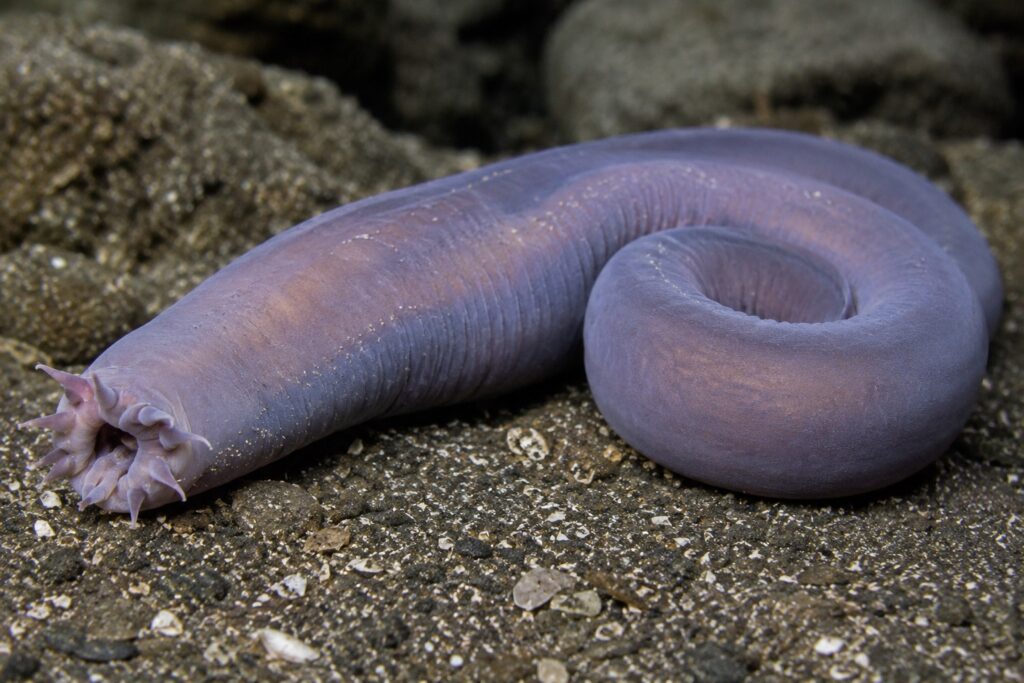
The hagfish looks like someone tried to draw an eel from memory after a bad night’s sleep. It is long, pinkish, soft, and kind of… floppy.
No jaw. No real eyes. No scales. No bones either, because it has a skull but no actual spine, which makes it less of a fish and more of a philosophical question.
Scientists still argue about whether to call it a fish at all. But the hagfish does not care. It has been eating dead things on the ocean floor long before science had opinions.
It has four hearts. Four. Most creatures manage just fine with one. The hagfish looked at that and said, “No, I want four.”
Nobody knows why it needs four hearts when it barely has a face, but here we are.
The Slime. Oh God, the Slime.
This is the part that makes people put their phone down and say “no.”
When a hagfish feels threatened, it releases slime. Not a little slime. Not “eew, gross” slime. We are talking about slime that expands in seawater to fill a bucket.
Slime that can clog the gills of a shark and make the most feared predator in the ocean swim away in a panic.
One hagfish can fill a bucket of water with thick, sticky, fibrous slime in less than a second.
The slime is not even regular slime. It is made of tiny threads that are, by weight, stronger than nylon.
Scientists have been studying it for years because it could be used to make bulletproof vests, surgical sutures, and shock absorbers. The hagfish has been sitting on a billion dollar idea this whole time and has used it for nothing but annoying sharks.
And after all that sliming, do you know what the hagfish does?
It ties itself into a knot. A literal knot. It loops its own body into a knot and slides the knot from its head to its tail to scrape the slime off itself. Then it goes back to its day.
Unbothered. Moisturized. Thriving.
How It Eats (You Might Want to Skip This Part)
The hagfish eats dead and dying animals on the ocean floor. Whales, fish, whatever sinks. It is a scavenger and it is very good at its job.
But the way it eats is the part that makes dinner feel less appetizing.
It burrows inside the carcass and eats from the inside out. No jaw, no problem.
It has two plates lined with sharp, tooth like structures it uses to tear off pieces of flesh. It goes in through any opening it can find, including the eyes, and it just… works from the inside.
If that were not enough, it can also absorb nutrients directly through its skin and gills while it is swimming. This means the hagfish can essentially eat without eating. It just exists near food and soaks it up like a very disturbing sponge.
Marine biologists call this a remarkable adaptation. Everyone else calls it the reason they did not sleep well last night.
It Has Been Around for 300 Million Years and Has Changed Almost Nothing
Here is what makes the hagfish genuinely impressive, not just horrifying.
Scientists found a fossil of a hagfish from about 300 million years ago. And it looked almost exactly like the hagfish alive today. Same shape. Same general design. Same “I do not need to evolve because I am already perfect” energy.
Sharks evolved. Whales evolved. Dinosaurs came and went. Ice ages happened. Continents moved. And the hagfish just kept being exactly what it is, scooting along the ocean floor, eating dead things, making slime, and tying itself in knots.
That is not a creature that failed to evolve. That is a creature that got it right the first time and had no reason to change.
There is a word for that in science. They are called “living fossils,” organisms so well built for survival that millions of years of change could not improve them.
The hagfish looked at evolution and said, “I am fine, thanks.”
People Actually Eat This Thing
Yes. Humans eat hagfish.
In South Korea, it is considered a delicacy. It is called “kkomjangeo” and it is usually grilled or stir fried.
There is even a hagfish festival in one town where locals celebrate the creature as part of their food culture. Vendors sell it on the street, grilled and served warm.
The United States exports tons of hagfish to South Korea every year.
Fishermen on the West Coast catch hagfish specifically for this trade, setting traps on the ocean floor and pulling up buckets of slimy, writhing hagfish to ship overseas.
The fishermen who do this job have the kind of confidence that cannot be taught.
So What Is the Point of the Hagfish?
You might be wondering why nature made this thing.
Here is the honest answer: the hagfish is a cleaner.
It does a job that nothing else wants to do. When a large animal dies and sinks to the ocean floor, something has to break it down. Hagfish show up in groups, sometimes dozens of them, and consume a carcass completely.
They recycle nutrients back into the ocean ecosystem. Without scavengers like the hagfish, dead animals would pile up on the ocean floor and rot in ways that would disrupt the entire deep sea food chain.
The hagfish is disgusting. But the ocean needs it.
It is basically the ocean’s janitor, showing up at 3am, doing the work nobody wants to see, and asking for absolutely no recognition.
The Lesson, If There Is One
The hagfish has no jaw. No spine. No real eyes. It eats dead things. It makes slime that can fill a bucket in a second. It survived three mass extinctions.
It has been alive in some form longer than trees have existed on land.
And it is still here.
Maybe the lesson is that you do not have to be beautiful, or fast, or impressive, or even technically a fish to survive. You just have to find your thing and be really, really good at it.
The hagfish found its thing 300 million years ago.
And it has been absolutely thriving ever since.