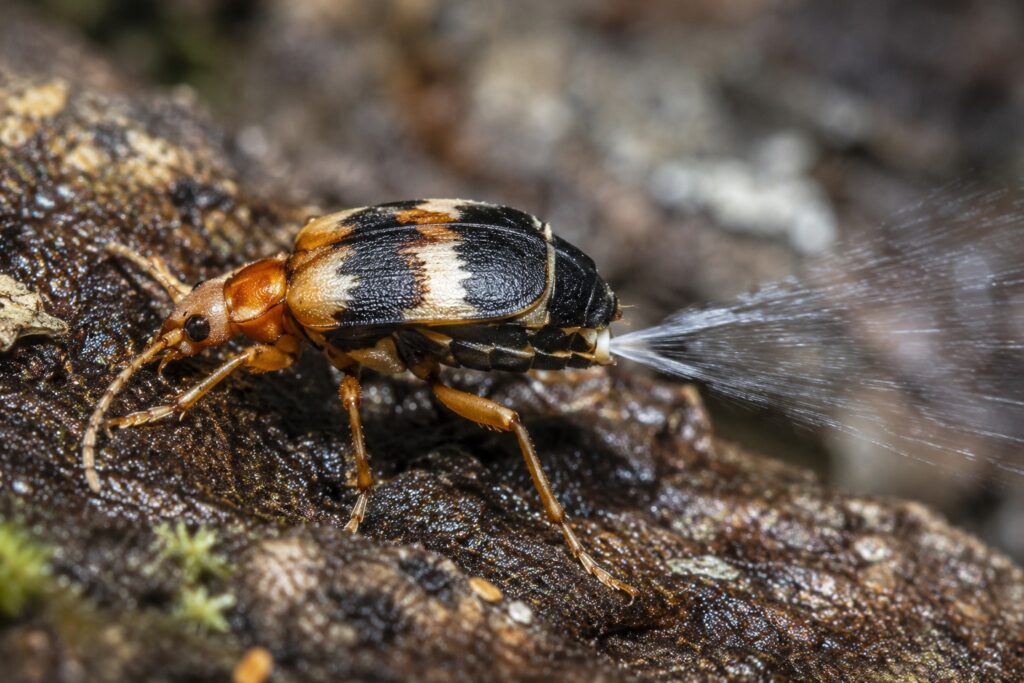
There is a beetle out there that, when it feels threatened, turns its backside toward you and fires a boiling hot chemical blast straight at your face.
No warning. No negotiation. Just a tiny insect looking you dead in the eye and saying, “Try me.”
Meet the Bombardier Beetle. It is small. It is unassuming. And it is absolutely not the one to mess with.
So What Exactly Is a Bombardier Beetle?
Bombardier Beetles are a group of ground beetles that belong mostly to the tribe Brachinini, inside the family Carabidae. There are over 500 species of them scattered across the world, from Africa to Europe to North America to Asia.
They are not rare. They are not hiding. They are just quietly living their lives and waiting for something to make the mistake of bothering them.
They look ordinary on the outside. Brown body, sometimes with a blue or dark green wing case, small legs, unremarkable face. You would walk past one and not think twice. That is exactly how it wants things to go.
Because if you do stop and bother it, things are about to get very unpleasant for you.
The Chemical Factory Living Inside a Beetle
Here is where things get genuinely incredible.
Inside the abdomen of a Bombardier Beetle, there are two separate storage chambers. One holds hydroquinones. The other holds hydrogen peroxide.
These two chemicals sit peacefully in their separate compartments, doing nothing, bothering no one.
But the moment the beetle feels threatened, it opens a valve and forces both chemicals into a special reaction chamber. Inside that chamber, enzymes called catalases and peroxidases are waiting.
And when all of these things meet, a rapid chemical reaction explodes into motion.
The result is a boiling hot spray of benzoquinone, a toxic and deeply irritating chemical, mixed with steam, fired out of the beetle’s abdomen at a temperature of about 100 degrees Celsius.
That is the temperature of boiling water. Coming out of a beetle. At high speed. With a popping sound.
Yes, It Makes a Noise Too
Because apparently just shooting boiling acid at things was not dramatic enough.
The spray does not come out in one smooth stream. It comes out in rapid pulses, about 500 pulses per second, creating a rapid popping sound as it fires.
Scientists who studied this in detail using high speed cameras discovered that the pulsing actually helps the beetle cool down the reaction chamber between each burst so it does not burn itself in the process.
The beetle has essentially invented a form of pulse combustion, the same basic principle used in certain jet engines, millions of years before humans figured it out.
Let that sink in. A beetle cracked the jet engine before we did.
The Aim Is What Really Keeps You Up at Night
If the boiling chemical blast was not enough, here is the part that makes the Bombardier Beetle truly unsettling: it can aim.
The tip of the abdomen is flexible and can rotate in almost any direction. The beetle can fire forward, sideways, and directly upward. It can target a predator’s mouth while being bitten.
It can adjust mid attack. In studies where beetles were grabbed by ants, the beetles directed their spray precisely at the ant’s head.
These are not random explosions. This is a guided weapons system inside an insect the size of your thumbnail.
It Has Even Escaped From Inside a Toad
In 2018, researchers in Japan published a study that documented something that sounds entirely made up.
A Bombardier Beetle, after being swallowed whole by a toad, survived inside the toad’s stomach, fired its chemical spray, and caused the toad to vomit it back out alive.
The beetle walked away.
The toad presumably sat very still for a while, rethinking its choices.
Of the beetles tested in the study, a significant number escaped this way, with some spending up to 107 minutes inside the toad before being expelled.
One hundred and seven minutes. Inside a toad’s stomach. And still came out fighting.
Why Does Any of This Exist?
Evolution is the short answer.
Over millions of years, beetles that had even slightly better chemical defenses survived longer and had more offspring.
Those offspring carried the same traits.
Generation after generation, the system became more refined, more effective, more precise, until you end up with what is essentially a biological flamethrower small enough to sit on your fingernail.
The Bombardier Beetle has been around for a very long time.
Fossil evidence suggests beetles similar to modern bombardiers existed tens of millions of years ago. The system works. It has always worked. Nothing in nature messes with it twice.
What Scientists Are Learning From It
Beyond just being fascinating, the Bombardier Beetle has actually caught the attention of engineers and researchers.
The beetle’s pulse combustion system, its ability to mix two reactive substances in a controlled chamber and release energy in rapid, efficient bursts, has been studied for possible applications in fuel injection systems and spray technology.
Nature, as it turns out, had already solved some problems that engineers were still working on. The beetle just never filed a patent.
The Bombardier Beetle is not dangerous to humans in any serious way.
The spray can cause irritation, a mild burning sensation, and probably a great deal of shock if you were not expecting it. But it will not send you to the hospital.
What it will do is make you deeply respect the idea that not everything small is harmless. Some things are small, calm, and completely prepared to ruin your day in ways you never saw coming.
The Bombardier Beetle does not start trouble.
But if you bring trouble to it, it will reach inside its own body, trigger a controlled chemical explosion, aim it at your face, and walk away while you deal with the consequences.
And somewhere in the tall grass, another Bombardier Beetle is going about its day, unbothered, unimpressed, and fully loaded.