Your body has been trying to talk to you for years. That tight chest before a hard conversation. The knot in your stomach when something feels off.
The way your shoulders crawl up to your ears when you are stressed. You are not imagining it. Your body is keeping score, and it has been doing so quietly, every single day.
This is what somatic wellness is all about.
Now, before your eyes glaze over at the word “somatic,” let us make it simple. “Somatic” just comes from the Greek word soma, which means body.
So somatic wellness is basically body-based healing.
It is the idea that your body is not just a vehicle carrying your brain around. It is an active part of how you process emotions, stress, and even trauma.
Think of it this way: your mind might forget a stressful event, but your body often does not.
The Body Remembers What the Mind Tries to Forget
You have probably heard of fight-or-flight. When you sense danger, your nervous system fires up and prepares your body to either run or fight. Heart racing. Muscles tensing. Breath getting shallow. It is a brilliant survival system.
The problem? Your nervous system does not always get the memo that the danger is over.
So even after a stressful situation has passed, your body can stay stuck in that alert mode.
Over time, this kind of stuck energy can show up as anxiety, chronic tension, fatigue, digestive issues, or just that general feeling of being “off” that you cannot quite explain.
This is not weakness. This is biology.
Dr. Bessel van der Kolk, a well-known trauma researcher, wrote a famous book called The Body Keeps the Score. His work showed that trauma does not just live in your head.
It literally changes the way your body functions. And healing, therefore, cannot only happen through talking about things. Sometimes, the body needs to be part of the process too.
So, What Does Somatic Wellness Actually Look Like?
Getting interesting, and honestly, a little surprising.
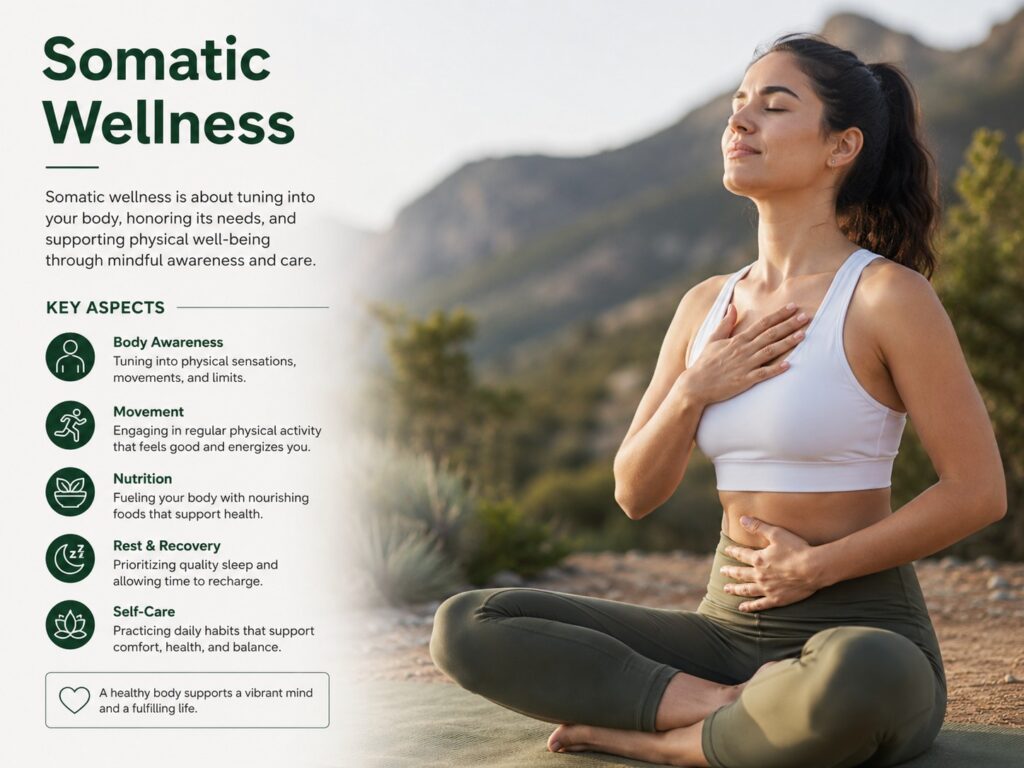
Somatic wellness is not one single thing. It is a whole collection of body-based practices designed to help you tune into your body, release stored tension, and regulate your nervous system.
Some of these might sound familiar. Others might sound a little out there. But stick with it.
Breathwork
This one sounds almost too simple to be real. Just breathe? Yes, just breathe.
But intentionally. Controlled, slow breathing activates your parasympathetic nervous system (the “rest and digest” side of things) and can calm your body down in real time.
It is not magic. It is just physiology.
Somatic Experiencing
Developed by Dr. Peter Levine, somatic experiencing is a therapeutic approach that helps people become more aware of their body sensations and gently process stored stress or trauma.
A trained practitioner guides you to notice what is happening in your body, without forcing anything.
It is slow, careful work, and many people find it genuinely helpful.
Body Scan Meditation
This is a mindfulness practice where you slowly move your attention through different parts of your body, noticing any tension, numbness, or sensation.
No fixing. Just noticing. Sounds boring, but it can be surprisingly powerful once you actually try it.
Movement-Based Practices
Yoga, tai chi, dance, and even walking can all be somatic practices when done with awareness.
The key is paying attention to how your body feels as you move, rather than just going through the motions.
It is the difference between exercising your body and actually listening to it.
Grounding Techniques
These are simple exercises that help you feel connected to the present moment through your senses.
Things like pressing your feet firmly into the floor, holding something cold or warm in your hands, or noticing five things you can see right now.
Simple, yes. Effective, also yes.
The Gut-Brain Connection Is Real (And Kind of Wild)
Here is a fun fact that makes somatic wellness make even more sense: your gut has its own nervous system.
Scientists call it the enteric nervous system, and it contains around 100 million nerve cells. Some researchers actually call the gut “the second brain.”
This is why anxiety often hits you in the stomach first.
Or why you get a “gut feeling” about something before your logical brain catches up.
The communication between your gut and your brain goes both ways, and it plays a big role in your overall emotional and physical wellbeing.
Somatic wellness takes this seriously.
It does not separate the mental from the physical. It treats them as one connected system, because that is exactly what they are.
Who Is Somatic Wellness For?
Short answer: pretty much anyone.
You do not need to have experienced major trauma to benefit from somatic practices.
If you carry stress in your body (and most people do), if you struggle to relax even when everything is technically fine, if you feel disconnected from your body, or if traditional talk therapy has helped but has not quite gotten you all the way there, somatic wellness might be worth exploring.
That said, for people dealing with serious trauma, working with a qualified somatic therapist is the right move.
This is not a space for guesswork or DIY approaches when the stakes are high.
A Gentle Warning About the Wellness Industry
Let us be honest for a moment. The wellness world can get a little… enthusiastic.
You will find all kinds of claims about somatic practices online, some grounded in solid research, and some that are mostly vibes dressed up in scientific-sounding words.
The core principles of somatic wellness are backed by real science. The nervous system research is solid. The mind-body connection is well-documented.
But not every practitioner is equally trained, and not every product slapped with the word “somatic” is worth your money.
Do your research. Look for practitioners with proper training and credentials. Be a little skeptical of anything that promises to heal everything with one session or one purchase.
Your body deserves real support, not just good marketing.
Somatic wellness is not a trend, and it is not a replacement for medical care. It is a growing and genuinely useful field that takes seriously what many of us have always sensed: that the body and mind are not separate systems.
They are deeply, constantly talking to each other.
And maybe it is time we started listening to what the body has been saying all along.
You do not have to start big. Try a body scan tonight. Take three slow, deep breaths the next time you feel overwhelmed. Notice where you hold tension in your body when you are anxious.
The body has been holding your stories for a long time. Somatic wellness just helps you start reading them.