This Tiny Animal Has Survived Five Mass Extinctions and It Does Not Even Care
There is a creature on this planet that has been through volcanic eruptions, asteroid impacts, ice ages, boiling heat, freezing cold, and the literal vacuum of outer space.
It is not a dinosaur. It is not a cockroach. It is not some secret government experiment gone wrong.
It is a tardigrade. And it is smaller than the dot at the end of this sentence.
So, What Exactly Is a Tardigrade?
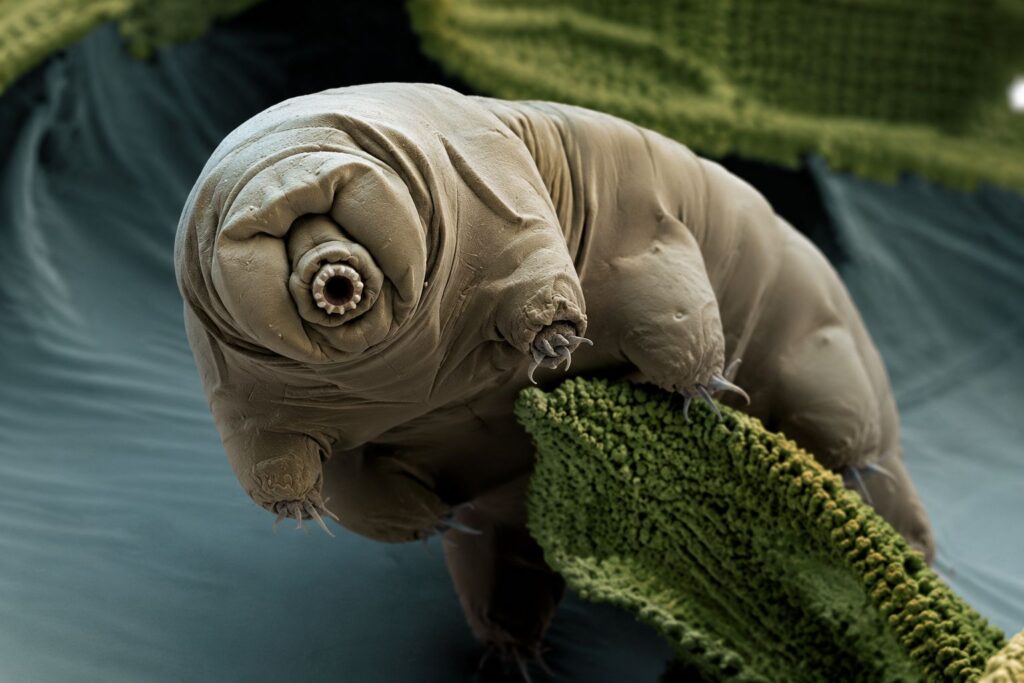
A tardigrade is a tiny, eight-legged animal that lives almost everywhere on Earth. Moss, ocean floors, mountain tops, rainforests, your backyard, and honestly, probably your face right now.
They are between 0.1 and 1.5 millimetres long, which means you need a microscope to see them properly.
Scientists have found over 1,300 species of tardigrades. They have been around for more than 500 million years. To put that in perspective, the dinosaurs only managed about 165 million years before they tapped out.
Tardigrades have been here three times longer and they are not even tired.
People also call them water bears because, under a microscope, they look like tiny fat bears waddling around with their little stubby legs. Some people call them moss piglets.
Both names are adorable. Neither name prepares you for how absolutely unhinged these animals are.
The Thing About Tardigrades Is That They Simply Refuse to Die
Let us go through the list of things that should kill a tardigrade but do not.
Extreme heat. Tardigrades can survive temperatures as high as 150 degrees Celsius. That is hotter than boiling water. They are fine.
Extreme cold. They can survive at temperatures close to absolute zero, which is around minus 273 degrees Celsius. That is the coldest anything can physically get. They are still fine.
Radiation. A dose of radiation that is 1,000 times higher than what would kill a human being? Tardigrades shrug it off. Scientists have blasted them with X-rays, gamma rays, and ultraviolet radiation. The tardigrades were unbothered.
The vacuum of space. In 2007, the European Space Agency sent tardigrades to space, exposed them to the full vacuum and radiation of outer space with zero protection, and brought them back. Most of them survived. Some of them even reproduced after coming back. They went to space. They came home. They had babies. Completely normal Tuesday for a tardigrade.
Dehydration. If a tardigrade dries out completely with no water at all, it does not die. It simply shrivels up into a tiny ball called a tun, shuts down almost all of its body functions, and waits. It can stay in this state for decades. Scientists have revived tardigrades that had been dried out for over 30 years. The tardigrade woke up, looked around, and went back to eating.
Crushing pressure. Tardigrades can survive pressure that is six times greater than what exists at the deepest point in the ocean. The Mariana Trench would not bother them at all.
How Do They Actually Do It?
The honest answer is that scientists are still figuring this out, but here is what they know so far.
When things get bad, a tardigrade goes into a state called cryptobiosis. This is basically the animal pressing the pause button on its own life. Its metabolism drops to less than 0.01 percent of its normal rate.
It loses almost all the water in its body. Its organs essentially stop working. From the outside, it looks dead. From the inside, it is just waiting.
Tardigrades also have a protein that scientists have named Dsup, which is short for Damage Suppressor. This protein literally wraps around the tardigrade’s DNA like a protective shield and stops radiation from tearing it apart.
Researchers have actually taken this protein and put it into human cells to see what happens. The human cells became more resistant to radiation. So tardigrades might one day help protect astronauts in space. The little creature is out here saving human lives and it does not even have a brain.
They Have Survived All Five Mass Extinctions
The Earth has had five major mass extinctions. The one that wiped out the dinosaurs was only one of them. Before that, there were four others, each one killing off the majority of life on Earth at the time.
Tardigrades survived every single one.
They were here before the first extinction. They are still here now. Scientists believe that because tardigrades can survive in so many different environments and can shut down their biology when things go wrong, they will likely outlive most life on Earth, including humans.
One researcher described them as the most likely animal to survive until the Sun expands and swallows the Earth. That is billions of years from now. The tardigrade is not worried.
Where Do Tardigrades Actually Live?
Everywhere. That is not an exaggeration.
They have been found in the Himalayas at elevations above 6,000 metres. They have been found in the deep ocean. They have been found in hot springs. They have been found in Antarctica under layers of ice. They have been found in tropical rainforests, in sand dunes, in soil, and in the gutters of buildings in cities.
The most common place to find them is in moss and lichens, which is why they got the name moss piglets.
If you scrape a bit of moss off a wall, put it in a drop of water, and look at it under a microscope, there is a very good chance you will find tardigrades walking around in there, completely at home.
They eat algae, plant cells, and sometimes other microscopic animals. They have a mouth that works like a tiny drill, and they use it to puncture plant cells and suck out the contents. Cute little face. Terrifying eating habits.
Why Should You Care About a Microscopic Animal?
Fair question.
For one, tardigrades are proof that life is more stubborn and creative than we usually give it credit for. When scientists think about where life might exist on other planets, they now think about planets that would have seemed completely impossible before tardigrades were studied.
If life can survive all the things tardigrades survive, then maybe it can survive on icy moons, or planets with extreme radiation, or places we used to dismiss entirely.
For another, the proteins and survival mechanisms inside tardigrades are being studied for real-world applications. Dsup, the radiation-shielding protein, is already being researched for medical use.
Other tardigrade proteins are being studied to see if they can help preserve vaccines, medicines, and even human organs without refrigeration. A tiny water bear might one day help doctors keep organs alive longer for transplants.
And honestly, sometimes it is just good for the soul to know that somewhere out there, a half-millimetre creature with eight stubby legs and a drill for a mouth has survived everything this planet has thrown at it for 500 million years and is currently sitting in the moss outside your window, completely unbothered.
Tardigrades are small. Tardigrades are weird. Tardigrades look like someone designed a bear in a fever dream and then shrunk it down to microscopic size.