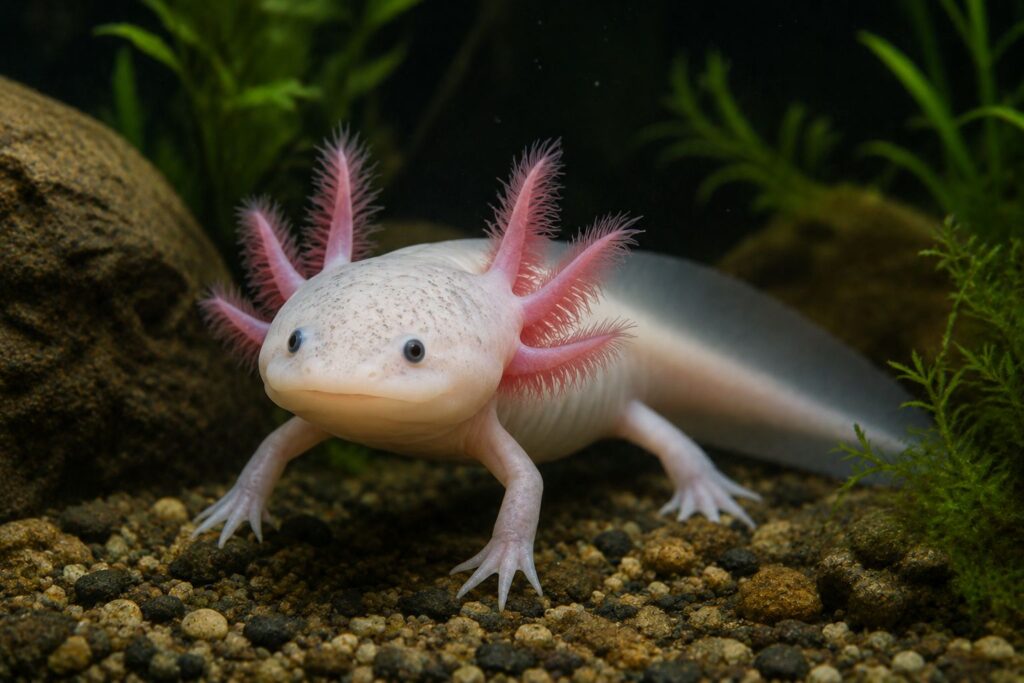
Axolotls, The Peter Pan of Salamanders
There is a creature living at the bottom of a lake in Mexico that has decided, very firmly, that growing up is not for it.
No thank you. Not interested. Hard pass.
While every other amphibian on the planet goes through metamorphosis, doing the whole “ugly duckling” thing of trading gills for lungs and crawling onto land like a responsible adult, the axolotl looked at that process and said, “I will not be doing that.”
And honestly? Respect.
Meet the axolotl (pronounced ack-suh-LAH-tuhl), the most unbothered animal in the world, and arguably the strangest thing evolution has ever produced on a slow Tuesday.
Axolotl Stays a Baby. Forever. On Purpose.
Most salamanders go through metamorphosis. They start as larvae, grow up, lose their gills, and become proper land animals.
The axolotl skips all of that. It keeps its feathery gills, stays in the water, and never becomes an adult salamander. Scientists call this “neoteny,” which is just a fancy way of saying it reaches full sexual maturity while still looking like a baby.
It is, biologically speaking, a grown adult that still looks like a kid. It reproduces. It has a full life. It just never “grows up” in the way its cousins do.
This is either the most brilliant life strategy in the animal kingdom or a very relatable cry for help. Scientists are still debating.
The Smile That Has No Reason to Exist
If you have ever seen a photo of an axolotl, you already know what we are talking about. That face. That permanent, upturned little smile.
It looks like it just heard a great joke and is politely waiting for you to finish speaking so it can go back to thinking about it.
The axolotl does not smile because it is happy. It smiles because the shape of its face is just built that way. But here is the thing. It does not matter.
The smile is there. It is real. And no matter how bad your day is going, one look at an axolotl’s face and something inside you just… relaxes.
This animal has accomplished more for human mental health than most things with a therapy license.
Axolotl Can Regrow Almost Anything. Yes, Anything.
Here is where things get properly jaw-dropping.
Axolotls can regenerate. Not in a small, boring way. In a completely unhinged, almost offensive way.
Cut off a limb? It grows back. Damage the heart? It repairs itself. Injure the spinal cord? Heals. Part of the brain? Also heals.
Scientists have transplanted eyes onto axolotls in places where eyes should not be, and the axolotl just connected them to its nervous system and started using them.
This animal is essentially unkillable by parts.
Researchers all over the world are studying axolotl regeneration to understand how it works, because if we can figure that out, the implications for human medicine are enormous. We are talking about regrowing damaged hearts, fixing spinal injuries, and possibly reversing nerve damage.
So yes. This tiny, smiling, Peter Pan salamander might one day help doctors regrow human organs.
It was out here quietly solving medical problems while wearing a permanent grin. Iconic.
It Comes in Different Colors and All of Them Are Adorable
Wild axolotls are usually dark, brownish, or greenish, blending into the muddy lake floors of their native habitat in Xochimilco, Mexico. But axolotls bred in captivity come in a range of colors that seem almost too cute to be real.
There is the classic wild type, which looks like a tiny muddy philosopher. There is the leucistic variety, which is pale pink with dark eyes and looks like a small, disappointed cloud.
There is the golden albino, which is yellow and glows faintly under light. And there is the melanoid, which is entirely dark and carries the energy of a goth who has accepted themselves fully.
All of them have those same feathery gill stalks fanning out from behind their heads like tiny, glamorous headdresses.
Axolotls did not come here to blend in. They came here to be seen.
They Are Critically Endangered in the Wild
Now here is where things get serious for a moment, because this matters.
Wild axolotls live in only one place on Earth: Lake Xochimilco, near Mexico City. And that lake is in serious trouble. Urban development, water pollution, invasive species like tilapia and carp, and shrinking water levels have pushed the wild axolotl to the edge of extinction.
A survey in 2014 found fewer than 35 axolotls per square kilometre in their natural habitat. More recent surveys have found even fewer. The animal that can regrow its own heart cannot outrun a bulldozer.
There are conservation programmes working to protect and restore their habitat, and many axolotls are kept and bred in captivity around the world, including in laboratories and as pets. But the loss of the wild population would be a real tragedy, both ecologically and scientifically.
The good news is that people are paying attention, which is more than can be said for most animals that are quietly disappearing.
Axolotls as Pets: They Are High-Maintenance Smiles
Axolotls have become popular pets in recent years, and it is not hard to see why. They are unusual, fascinating, and that face does something to people.
But they are not easy pets. They need cold, clean water between 14°C and 20°C (57°F to 68°F). They are sensitive to water quality.
They cannot be kept with most other fish. They eat live or frozen food like bloodworms and brine shrimp. And they are not cuddly. You cannot take one for a walk or teach it to fetch.
What you can do is sit in front of their tank and watch them drift around, smiling at nothing, and feel oddly at peace with the world.
Some people find that worth it. Those people are correct.
What Aztec Mythology Says About Them
The axolotl has been in Mexico for a very long time, and it showed up in Aztec mythology. The name “axolotl” comes from the Nahuatl language and is associated with Xolotl, the dog-headed god of lightning, fire, and the underworld.
According to myth, the gods were being asked to sacrifice themselves to keep the sun and moon moving. Most of them agreed. Xolotl panicked, transformed himself into a maize plant, then into a double maize plant, then finally into an axolotl in Lake Xochimilco, trying to escape his fate.
So the axolotl is, essentially, a god who turned into a lake creature while running away from responsibility.
It really is the Peter Pan of salamanders in every possible sense of the word.
The axolotl is one of the most remarkable animals on the planet. It refuses to grow up, regenerates its own organs, looks like it is perpetually delighted to see you, comes in colours that should not exist in nature, and was once a god trying to dodge a divine obligation.
It is also disappearing from the wild, which should make us genuinely uncomfortable.
If there is one thing to take from this strange, smiling little creature, it is this: the world is a much weirder and more wonderful place than we give it credit for.
And some of the most important things in it are hiding at the bottom of a shrinking lake in Mexico, growing back their limbs and grinning about it.
Go look up an axolotl video. Your day will be better for it.