You wake up. Before your feet even touch the floor, your brain is already running at full speed. You are thinking about your to-do list. You are replaying that awkward thing you said three days ago. You are worried about something that has not even happened yet. And it is not even 7 AM yet.
So what do you do? Some people meditate. Some people go for a run. And some people lie down in a room full of strangers while someone bangs a gong near their head.
That last one is sound bath therapy. And before you click away, hear this out. It is a lot more interesting than it sounds.
What Even Is a Sound Bath?
First things first. A sound bath has nothing to do with water. You are not climbing into a tub. Nobody is scrubbing your back. The word “bath” here means you are being soaked in sound. Like, surrounded by it completely.
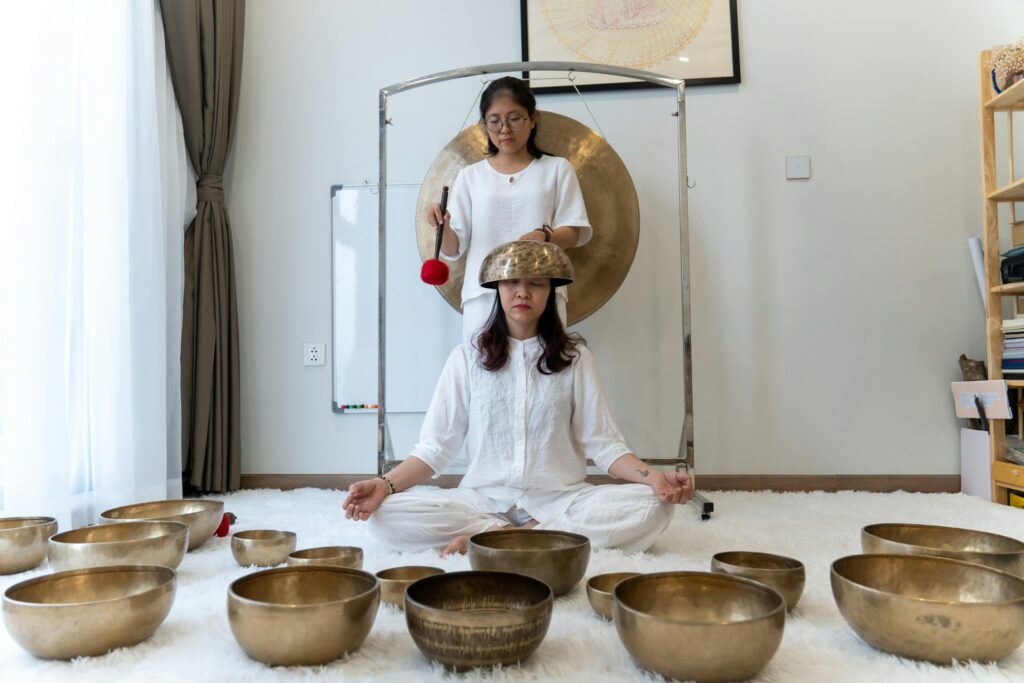
A sound bath session usually involves lying down on a mat, closing your eyes, and letting a practitioner play instruments around you. These instruments are often Tibetan singing bowls, crystal bowls, gongs, tuning forks, or chimes. The sounds overlap and layer on top of each other, creating these rich, almost humming vibrations that seem to go right through your body.
That is it. You just lie there. Honestly, that alone already sounds like a good deal.
Where Did Sound Bath Come From?
Sound as a healing tool is not new. Not even close. Ancient cultures across Tibet, Egypt, Greece, and Indigenous communities around the world have been using sound and vibration as part of spiritual and healing practices for thousands of years. Tibetan monks used singing bowls in meditation for centuries. Indigenous communities used drumming in ceremonies to shift states of consciousness.
Modern sound bath therapy takes inspiration from these traditions and adds what we now know about how sound affects the brain and body.
So no, this is not just a wellness trend that someone made up last Wednesday.
How Does Sound Bath Work on the Brain?
Your brain operates on different wave frequencies depending on what you are doing. When you are stressed, focused, or anxious, your brain runs mostly on beta waves. These are fast, active, and sometimes exhausting. When you relax or drift toward sleep, your brain shifts into alpha and theta waves. These slower states are linked to calm, creativity, and clarity.
Sound bath therapy uses a process called brainwave entrainment. The vibrations and frequencies from the instruments can actually encourage your brain to shift from those fast, chaotic beta waves into slower, calmer alpha and theta states. Your brain starts to sync with the rhythm of the sound around it.
It is a bit like how a loud, fast song at a party makes you want to move, but a slow, quiet song at night makes you want to sit down and zone out. Sound changes your mental state. Sound bath therapy just does this in a very intentional and structured way.
So What About Mental Clarity?
Mental clarity is one of the most common reasons people go to a sound bath. And this makes a lot of sense when you understand what the session actually does.
When the brain shifts into those calmer wave states, a few things happen. The nervous system relaxes. Cortisol levels (that is your stress hormone) tend to drop. Racing thoughts slow down. And the mental clutter that has been piling up starts to feel a lot lighter.
Think of your mind like a browser with 47 tabs open. A sound bath does not close all the tabs. But it gives you a moment where the screen stops freezing, the noise quiets down, and you can actually see what is in front of you.
After a session, many people report feeling more focused, more emotionally settled, and more mentally present. Some people say they had insights or ideas come to them during the session, which tracks with the theta brain state being linked to creative and intuitive thinking.
What Does the Research Say?
Fair question. And the honest answer is that the research is still growing. Sound bath therapy is not a replacement for clinical mental health treatment, and nobody should tell you it is.
That said, there are some promising findings. A 2016 study published in the Journal of Evidence-Based Complementary and Alternative Medicine found that a Himalayan singing bowl meditation significantly reduced tension, anxiety, and depressed mood in participants.
Another study found that sound meditation helped reduce feelings of tension and physical pain.
Research is still catching up with the practice, but what exists so far is encouraging. And for something this low-risk and non-invasive, that is a solid starting point.
What to Expect If You Try One
If you are curious and want to try a session, here is a rough idea of what it looks like.
You show up and find a spot on a mat. You might be given a blanket or an eye mask. The practitioner will guide you to relax and get comfortable. Then the sounds begin.
For the next 45 minutes to an hour, you just breathe and listen. Some people feel deeply relaxed. Some people feel emotions come up unexpectedly. Some people drift in and out of a dreamy half-sleep state. Some people fall completely asleep and wake up slightly embarrassed by their own snoring (it happens, and nobody cares).
After the session, you will likely feel quiet. Calm. A little spacey in a pleasant way. Most people describe it as similar to waking up from a really good nap, except your mind actually feels cleaner.
Is Sound Bath for Everyone?
Pretty much yes, with a few small caveats. People with certain medical devices like pacemakers should check with their doctor before attending, since some gongs and bowls produce strong vibrations.
If you have sound sensitivities or certain neurological conditions, it is also worth checking in with a healthcare provider first.
But for the average person who is just tired of feeling mentally foggy and overwhelmed? It is a genuinely accessible, gentle, and enjoyable thing to try.
Sound bath therapy is not magic. It is not going to solve your problems, pay your bills, or make your inbox disappear. But what it can do is give your brain a real break. A proper one. The kind where you actually come back feeling like yourself again.